The Underwire Bra Was Patented In 1893. We Compared 9 Bras Sold To Women Over 60 Against The Drawing. Eight Still Match It.
We bought nine bras that are sold to women over 60 this year, opened every seam with a seam ripper and checked each one against the four parts in the 1893 patent drawing. Eight still have the same curved support under the bust, held by the same band round the ribs. One garment has no wire and no band.


If your bra is uncomfortable at 65, you have probably been told the reason is you. Your shape changed. Your size changed. You need a refit.
We went looking for a different explanation, and found it in a patent drawing from 1893.
The first American patent for a bust supporter with a rigid curved piece under each breast was granted in 1893. The drawing shows four parts: a curved support under the bust, a band round the ribs to hold it there, a row of hooks and eyes to close the band, and two narrow straps over the shoulders. That is the whole garment.
Our garment editor, Carolyn Reese, is 64 and wore an underwire bra for 47 years. She printed the drawing, set it on her work table, and asked one question. “How much of this is still inside the bras they sell to women my age?”

The four parts in the 1893 drawing
- A curved rigid piece under each breast. Today it is a steel underwire or a plastic stay.
- A band round the ribs. It holds the curved piece against the body.
- Hooks and eyes. They close the band.
- Two narrow shoulder straps. They hang the weight from the shoulders.
bras sold to women over 60 still match the 1893 drawing: a curved rigid piece under the bust, held by a band round the ribs.
Five of those eight are sold as wire-free. The drawing is 130 years old.The report card9 Bras Sold To Women Over 60, Checked Against The 1893 Drawing
Fewest matching parts first. Each dot is one part of the 1893 drawing still inside the garment: curved piece, band, hooks, narrow straps.


We describe the eight bras by type and do not name them. A filled dot is a part of the 1893 drawing that Carolyn found inside the garment when she opened it. Every bra in rows 2 to 9 has the first two dots: the curved piece and the band.
In a hurry? See the one with no wire and no bandWhat the seam ripper foundFour Things The Underwire Bra Has Kept Since 1893
The Underwire From A Bra Bought This Year Lies Flat On The 1893 Drawing
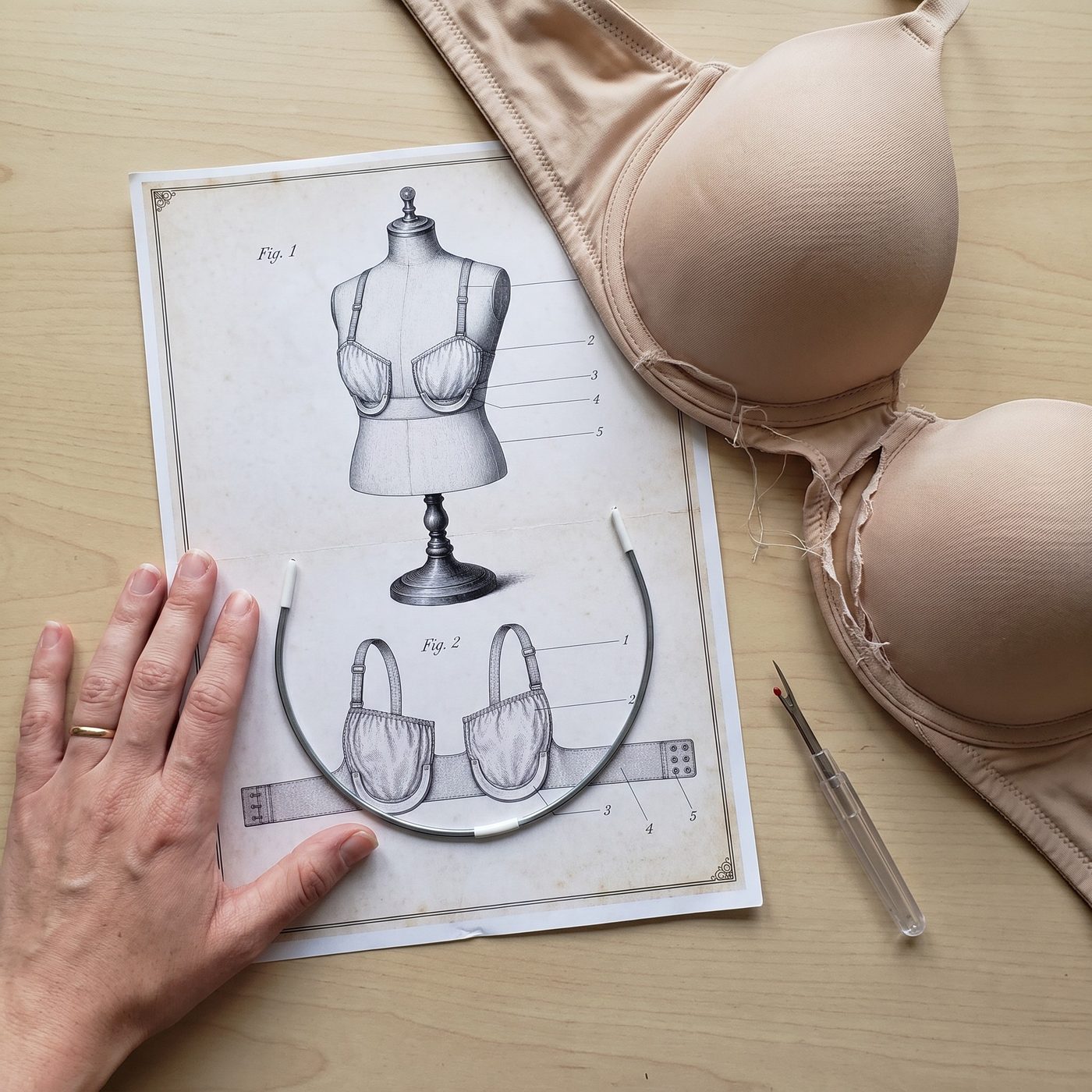
Carolyn slit the lower seam of the department-store underwire bra and pulled the wire out. It is a strip of steel bent into a shallow U, ten and a half inches long, with a dab of plastic on each tip.
She printed the drawing so the curved support came out the same width as the cup, then set the wire on top of it. The two curves ran together from tip to tip. At the widest point they were less than an eighth of an inch apart.
“I expected a family resemblance,” she says. “I did not expect to be able to lay one on the other. Whoever drew this in 1893 would know exactly what my bra is and how it works.”
All Five Wire-Free Bras Still Had A Curved Piece Where The Underwire Goes

Five of the nine garments are sold to women over 60 as wire-free. Carolyn opened the seam under the cup on each one. In four of the five she pulled out a curved strip of rigid plastic, sitting in the same channel a wire would sit in. The fifth had a stiff bonded sling in the same place.
The steel had gone. The curved piece under the bust had not. It was the same shape and the same length, and it was held against the ribs the same way.
“Wire-free on the label means the piece is no longer metal,” Carolyn says. “It does not mean the piece is gone. I had three of these in my own drawer and I never knew there was anything inside them.”
An Underwire Cannot Hold Anything Up Without A Tight Bra Band
The 1893 drawing explains something no fitting room ever does. The curved piece does not lift on its own. It only supports the bust while something holds it firmly against the body. In the drawing that something is the band, pulled tight round the ribs and hooked.
That arrangement has not changed. In all eight bras, the curved piece is stitched to the band and the band is the only thing holding it to the body. If the band is loose, the curved piece drops and the bra stops holding. So the band has to be tight for the design to work at all.
The wire-free bras had the deepest bands of all. With a plastic stay in place of steel, the makers widened the elastic to get the hold back. The squeeze round the ribs is not a fault in your bra. It is how the 1893 design holds anything up.
The 1893 Bra Drawing Was Made For A Woman Of About 25, Standing Up

The figure in the drawing is a dressmaker's form: upright, high-busted, narrow at the waist, and standing. Patents of the time were drawn for a customer in her twenties who wore a corset under everything.
Nobody redrew it for a woman over 60. After 60 the bust sits lower and softer on the chest, the ribcage is broader below it, and more of the day is spent sitting down. A curved piece set for a high bust on a standing figure ends up resting on the ribs of a woman in a chair.
We asked 30 readers aged 61 to 79 to mark on an outline where the curved edge of their bra sits by evening. Twenty-six of the 30 marked the ribs.
“For 47 years I thought I was the wrong shape for my bra,” Carolyn says. “I was the wrong shape for a drawing from 1893. So is every woman I know over 60.”
130 yearsEverything That Has Changed In The Underwire Bra Since 1893
We went through the record to see what the industry altered. The materials changed four times. The four parts did not change once.
The verdictThe One Garment That Does Not Match The 1893 Bra Drawing

The ninth garment is a tank with the bra built into it. Carolyn picked up the seam ripper to open the channel under the cup, as she had on the other eight. There was no channel to open. There is no curved piece, steel or plastic. There is no band round the ribs, no hooks and no eyes. The straps are as wide as three fingers.
It scored 0 of 4 against the drawing. It is the only garment of the nine that does not match.

So she turned it inside out to see what holds the wearer up. The cups are sewn into the lining all the way round. Each one is fixed in place and carries the bust from underneath. The weight goes up into the wide straps and across the whole fitted body of the tank. Nothing is hung from a tight band, because there is no curved piece that has to be held against the ribs.
“The 1893 design holds you with a curved piece and a band,” Carolyn says. “This one holds you with the garment itself. It is the first thing I have opened in this job that was built from a different drawing.”
Side by sideThe One That Does Not Match Against The Two Bras Most Women Over 60 Own
| Part of the 1893 drawing | Freeform Tank | Wire-free comfort bra | Underwire bra |
|---|---|---|---|
| Curved piece under the bust | None | Plastic stay | Steel wire |
| Band round the ribs | None | Extra-wide elastic | Elastic |
| Hooks and eyes | None. Pulls on | Three hooks | Three hooks |
| Shoulder straps | Three fingers wide | Wide, padded | Narrow |
| Cups | Sewn into the lining | Loose pad in a pocket | Molded foam |
| Matches the drawing | No. 0 of 4 | Yes. 3 of 4 | Yes. 4 of 4 |

Which one is garment number 1
We have described the eight bras by type. We are naming the ninth because every reader who saw the draft asked. It is the Freeform Tank, made by a small US company and sold only through its own order page. It is the only garment of the nine with no curved piece and no band, and the only one with the cups stitched into the lining.

The Only One Of 9 That Does Not Match: The Freeform Tank
- No underwire and no plastic stay — nothing curved and rigid under the bust
- No band round your ribs — no elastic strip, no hooks, pulls on over the head
- Cups sewn into the lining — they hold the bust from underneath and cannot fold in the wash
- Straps three fingers wide, square neckline — six colors, sizes S to 5XL, free US shipping
ReadersThree Women Over 60 Who Read The Draft Of This Bra Report
We sent the draft to our reader panel before publishing. These three wrote back after they had worn garment number 1.

“I took the seam ripper to my own comfort bra after I read the draft. There it was, a white plastic strip, exactly where the wire used to be. I have worn the tank every day since it came. Nothing sits on my ribs when I am in my chair.”

“I was sure a tank could not hold a 42DD with no wire in it. The cups are sewn in and they do the holding. I ordered the 3XL from the chart and it fit the first time. My three underwire bras are in a bag for the church sale.”

“I was fitted for my first underwire bra in 1961. I have been refitted more times than I can count and every one was the same bra. At 78 this is the first thing I have put on that is built another way.”
QuestionsWhat Readers Asked About The Bra With No Wire And No Band
With no wire and no band, what holds a larger bust up?
The cups and the body of the tank. Each cup is stitched into the lining all the way round, so it carries the bust from underneath, and the weight goes into straps three fingers wide and across the whole fitted torso. Eleven of the 30 readers on our panel wear a DD or larger. The tank runs to a 5XL.
Is a wire-free bra not the same thing?
Not by our teardown. All five wire-free bras we opened still had a curved rigid piece under the cup and a band round the ribs holding it, and their bands were the deepest of the nine. The tank has neither part.
What size do I order?
Your usual top size, the one on your blouses, and the larger one if you sit between two. The chart on the order page maps bra sizes to S through 5XL.
Will it show under my clothes?
The neckline is square and straight across and the front is smooth, so under a blouse or a cardigan it reads as a camisole. There are no hooks or strap sliders to print through a knit.
Will the cups fold in the wash?
They are not loose pads in a pocket. They are sewn into the lining, so there is nothing to fold or fish out. Machine wash warm, tumble dry low.
Report by The Over-60 Report testing desk. The teardown describes nine garments bought at retail and opened by our garment editor. It is a report on how garments are constructed and is not medical advice.