
7 Things That Happen To A Man's Bladder When He Holds It All Day
The worst bladders I see do not belong to men in their seventies. They belong to men in their forties who drive for a living or work on sites. Not one of them was ever warned.


I am a urologist, and I am going to tell you something that surprises people at dinner parties.
The bladders that look worst on a screen are not the oldest ones. A seventy-eight-year-old who has been retired for fifteen years and pottered around a garden usually has a bladder wall I would call unremarkable. The ones that stop me are men in their forties and early fifties, and when I look at what they do for a living it is the same short list every time. Long-haul. Delivery. Rideshare. Sparkies, plumbers, roofers, anyone on a site without a site toilet worth using.
Here is the thing I want to be straight about. None of this is because he was careless. Every single one of these men did the sensible thing given the job he had. The job is what is unreasonable.
Seven things. The first five he will recognise before he finishes the sentence. The sixth is what is actually going on, and nobody has ever checked it.
You Hold It For Nine Hours Because There Is Nowhere To Stop
Start with the obvious one. There is no bathroom on a motorway, there is no bathroom halfway up a roof, and a delivery run does not have slack in it for a detour. So you hold it. Not once — every shift, for years.
Urine that sits in a bladder for hours keeps concentrating. The longer it sits, the more mineral and acid content per millilitre, and the more of that content ends up deposited on the wall of the bladder rather than leaving with the rest of it.
Do that five days a week from twenty-five to forty-five and the wall is carrying two decades of it. That is not a slow version of what happens to everybody. It is a faster one.
You Drink Less On Purpose So You Do Not Have To Stop
This is the one almost nobody admits to a doctor, and almost every driver does.
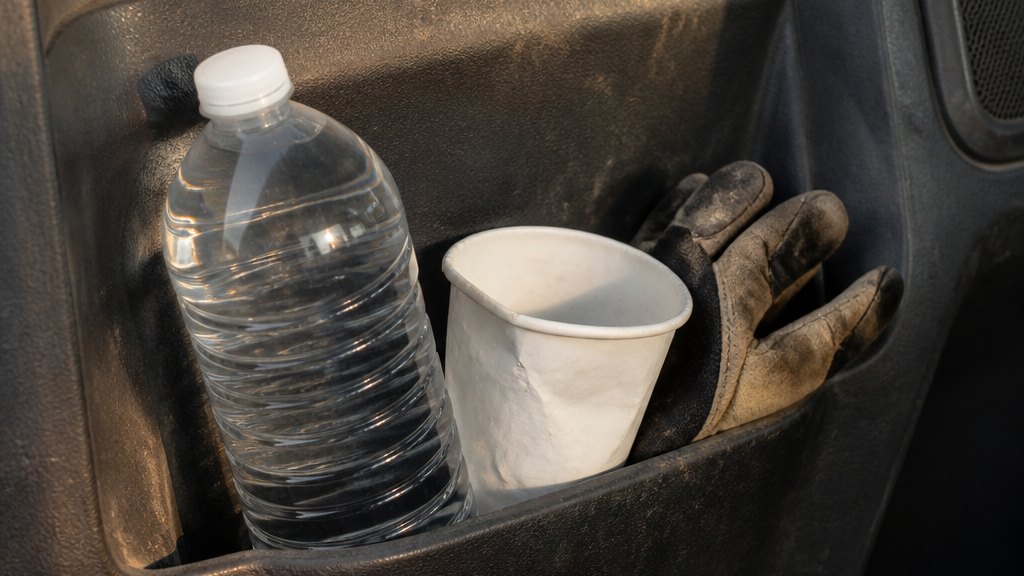
You worked out years ago that the way to avoid needing a bathroom is to not put anything in. So the bottle sits in the door of the cab all shift and goes home nearly full. It works, and it is exactly the wrong solution.
Cutting the water does not reduce what your kidneys filter out. It concentrates it. You end up with a smaller volume of far harsher urine sitting against the bladder wall for longer, which is the precise combination that leaves deposit behind.
The man who drinks nothing all shift and goes twice a day is doing more damage than the man who drinks properly and stops four times.
Your Water For The Day Is Servo Coffee And An Energy Drink
I am not going to tell you to give up coffee. You are up at four and I am not stupid.
But be clear that it is not counting as water. Caffeine at the volume a driver takes it makes the kidneys work harder while you are also putting in less plain fluid, and the energy drinks add a large sugar and acid load on top. The result in the bladder is the same as everything else on this list: a smaller volume of more aggressive urine, sitting there longer.
Two coffees and a can is a normal day in a cab. It is also four separate reasons for the wall to pick up deposit.
You Empty Standing, In A Hurry, And Never Quite Finish
When you do finally stop, you have got ninety seconds and you are already thinking about the run. You go, you shake, you are back in the seat.
The problem is that a bladder that has been held for five hours does not empty in one go. The muscle has been stretched hard for hours and it does not contract cleanly at the end of that. There is a residue left behind every single time, and that residue is the most concentrated part of what was in there.
Then it sits for another five hours with the next lot on top of it. Men who tell me they finish and then need to go again twenty minutes down the road are describing this exactly.

If you are nodding at four out of four so far, none of that is the part that is going to change anything. Number six is.
See The Three-Step ProgramYou Sit On It For The Entire Shift
Ten hours in a seat is its own problem, separate from the holding.
Sitting for long unbroken stretches slows circulation through the whole pelvic floor, and everything down there gets less movement and less drainage than it was built for. In a cab you can add constant low-frequency vibration through the seat to that, hour after hour.
None of that on its own wrecks a bladder. What it does is make every other item on this list land harder, and it is why a driver and an office worker who both hold it all day do not end up in the same place.
Nobody Has Ever Looked At What Is Sitting On Your Bladder Wall
Here is what the first five things have been building up to, and it is the part no GP appointment has ever covered.
A healthy bladder wall is pink, wet and smooth. Put a scope into a man who has driven for twenty years and there is something on it: a pale, gritty, chalk-coloured film, laid down in layers and stuck to the tissue. Mineral salts and acid crystals that came out of his own urine, one held shift at a time.
That coating does two things. It gives a surface texture where there should be none. And it stiffens the wall, so it stops stretching properly — which means it reports full when it is about a third full.
That is the whole story. The urgency that arrives out of nowhere at eighty on a motorway is not a weak bladder. It is a coated one sending the signal far too early, and then you get there and there is barely anything in it, and you cannot work out why you were that desperate.

You Are 44 And You Have Decided This Is Normal For The Job
Every trade has a thing the older blokes tell you to expect. Knees for roofers. Backs for removalists. Hearing for anybody who spent the eighties near a saw.
For drivers it is this, and it gets passed down the same way — a shrug, and some version of yeah, that is the job. So a man of forty-four with a bladder that is behaving like a man of seventy-five files it under occupational and never mentions it to anyone.
It is common in your trade. That is true. But common is a description of how many men it happens to, not an explanation of why, and the why is sitting on the wall of your bladder where nobody has looked.
So — What Actually Takes The Deposit Off?
Once you know the wall is coated, the question stops being how do I hold on longer and becomes how do I get the surface back.
That is three separate jobs and they have to happen in order. Stop new deposit adhering. Loosen what has already bonded to the tissue. Settle the irritated lining underneath so it stretches again and stops calling full at a third.
Skip the first two and you have quietened a wall that is still coated. Skip the third and you have stopped it getting worse while the run to Bakersfield is exactly as bad as it was.
“Most of the bladders I scope are not weak. They are coated. We have spent thirty years treating the signal and almost none of it looking at what the signal is coming off.”
— Dr. Alan Reeves, MD
Here is the sequence, and what each part is actually doing.
CranShield™
Proanthocyanidins at extract strength rather than juice strength, so new mineral and acid deposit has far less to hold on to. Astragalus is here because a lining that is already irritated lays down more, faster.
Sedraclear™
Chanca Piedra translates out of the Spanish as stone breaker, which is what it has been used for along the Amazon for as long as anyone has written it down. Its job here is the crystalline deposit sitting on the wall — loosening the bond so it lifts and leaves in the ordinary way, at the ordinary volume.
UrsiCalm™
Under the deposit is tissue that has been irritated for years and is reporting full long before it is. This is the part that decides whether the day feels different, because a calm lining stretches, and a lining that stretches stops raising the alarm at a third of a bladder.
Every one of those is available on its own, and most of them are cheap. That is not the difficulty. The difficulty is that the three steps have to happen in order and at weights that do something — stop the deposit, lift the deposit, settle the tissue under it — and buying nine bottles to do that is how people give up in week three.
The formulation my team put together is called Rensa. Two capsules, once a day, all three steps at the weights above. It is not a diuretic and it is not a water pill. It is not designed to make you go more. It is designed to take the deposit off the wall so the wall stops reporting full when it isn't.