"The Hardest Thing My Arthritis Patients Do All Day Isn't Walking. It's Putting On a Bra."
An occupational therapist with 29 years in outpatient rehab explains why the clasp behind your back is the single most punishing movement of a stiff shoulder, and the one change she now tells every woman to make.

- 29 years in outpatient hand and upper-limb rehab
- Has taught dressing technique to more than 4,000 patients with arthritis

When a new patient with shoulder or hand arthritis comes to me, I ask her to walk me through her morning. Not her pain scores or her medication. Her morning.
And almost every time, somewhere between the bathroom and the kitchen, she goes quiet and says something like: "And then there's the bra. My husband does it up for me now." Or: "I just don't wear one anymore. I don't go out much anyway."
After 29 years I can tell you this plainly: for a woman with a stiff shoulder, fastening a bra is the hardest thing she will do all day. Harder than the stairs. It's the task that quietly ends the most independence, and hardly anyone talks about it.
Why a Bra Clasp Is the Worst Movement You Can Ask of a Stiff Shoulder
Reaching behind your back to hook a bra asks your body for three things at once, and arthritis takes away all three:
Put those together and you have a movement that would be awkward for a healthy 30-year-old. Hand it to a 70-year-old with an arthritic shoulder every morning of her life, and something has to give.
What Women Quietly Give Up, in the Order They Give It Up
None of those stages is about vanity. Every one is about the same thing: whether a woman feels dressed enough to live her life.
Why the "Comfort Bras" Don't Solve It

Patients bring me every kind: wireless, "seamless", pull-on sports bras, front-closure bras. Each fixes one problem and keeps the rest.
The Five Things I Now Tell Every Patient to Look For
My dressing checklist
- 1Nothing to fasten, anywhere. No hooks, clasps or zips. If it needs a pinch grip, it fails.
- 2It goes on over the head, loosely. The arms should barely lift, and nothing should need stretching over the shoulders.
- 3No band round the ribs. Support should come from the cups, not from compressing the chest.
- 4Wide, flat straps. They spread the load and don't slide off a shoulder that has dropped.
- 5Cups that can't move. Sewn in, not a pad in a pocket, so there's nothing to fish out and reposition with sore fingers.
For years I couldn't point to one garment that passed all five. Then a patient walked into a session last winter, lifted her arms a few inches and said, "Look. I did this myself."
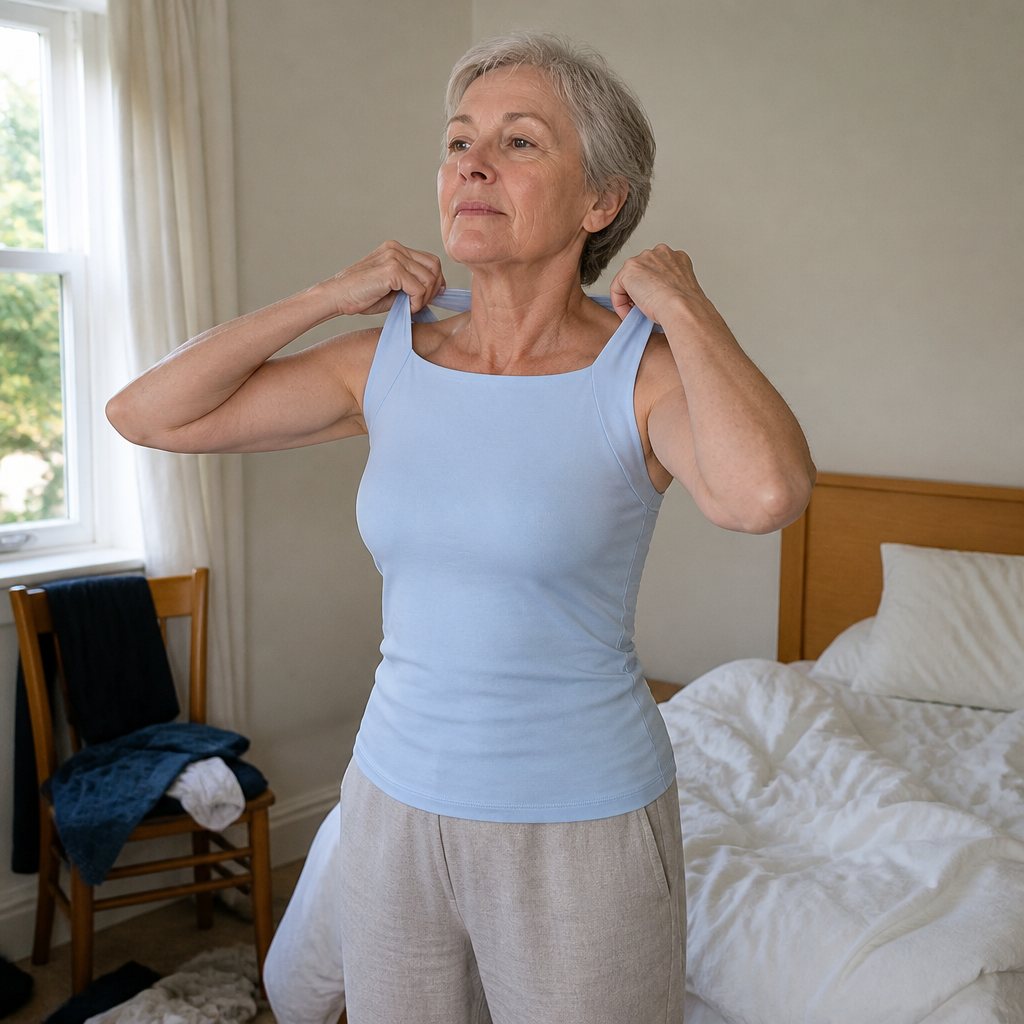
The Tank That Passed All Five
It was a tank top with the bra built in, called the Freeform Tank. Shaped cups are stitched permanently into the front. There's no band, no wire and no clasp, the straps are wide and flat, and the body is cut long and loose enough to slip over the head without stretching.
I was sceptical. I've seen plenty of built-in-bra camisoles, and most are a loose foam pad in a pocket. So I did what I'd do with any dressing aid: I tried it with my own patients.
What Happened When 12 of My Patients Tried It
Twelve women, aged 61 to 84, all with shoulder or hand arthritis and all of them needing help, or a workaround, to get a bra on. Each got a Freeform Tank in her size and wore it for two weeks.
The number that stuck with me wasn't on any chart. At the two-week check, three of the women told me they'd been out for lunch that week, because getting dressed had stopped being the hard part of the day.

"My husband has done my bra up every morning for six years. The first day I wore this I walked into the kitchen dressed and he just looked at me. I cried a bit, honestly."

"I can't lift my right arm above my shoulder. This goes on with my arms down low, and it holds me properly, not like those flimsy camisoles."

"My hands are the problem, not my shoulders. No hooks means no fumbling. I've ordered five so I never have to think about it."

My Advice If You Recognise Yourself
If someone else fastens your bra, if you've started skipping it, or if you've given up on going out because getting dressed wears you out, try a garment that doesn't ask your shoulder for the one movement it can't give you.
Order your usual top size; there's a size chart on their order page. I tell patients to get more than one so there's always a clean one in the drawer. The multi-packs make that cheaper per tank, and you can choose a different colour for each.

Freeform Tank: reader offer
You're at a Crossroads
Keep doing what you're doing
Tomorrow morning is the same fight: the twist, the reach, the pinch. Or asking for help, or going without and staying in.Try the one that passed
Pull it over your head and you're dressed and supported, on your own, in ten seconds. If it isn't right within 45 days, it's exchanged or refunded.214 comments