A Retired Seamstress Took Apart 11 Bras Sold To Women Over 60 And Ranked Them By What She Found Inside. Only One Had The Cups Sewn In.
Forty years at an industrial machine taught Dorothy Kalman to judge a garment from the inside. So she washed eleven bras and built-in-bra tanks sold to women her age twenty times each, cut every one open on her sewing table, and graded them on what the stitching, the glue and the elastic had actually done. Ten were a foam pad held in by glue or a pocket. One was something else.


Dorothy Kalman sewed for a living from the age of nineteen. Forty years at an industrial machine in a Reading, Pennsylvania garment plant, most of them on lingerie and foundation wear, then eleven more altering bridal gowns from her spare bedroom. She is seventy-one now. She has worn a bra every day of her adult life, and she has the same strap groove on her right shoulder that half the women reading this have.
What started the teardown was her sister's bra. It came out of the washing machine in July with the foam pad folded in half inside the cup, and her sister asked Dorothy whether it could be fixed. Dorothy turned it inside out, ran her thumb along the cup edge, and felt the thing she had spent forty years being told to look for on a factory floor: a line of dried glue where a line of stitching should have been.
"I said to her, that is not a sewing fault. Nobody sewed that pad in. They glued it, and warm water lets glue go." She bought ten more, all sold to women over 60, and did the same thing to every one.
- How the cup is held in — stitched into the lining, loose in a pocket, or glued.
- What the band elastic did by wash 20 — how much longer it lay when relaxed.
- Whether there is a wire, and what the wire channel looked like at the tips.
- Strap width and stitching — rows of stitching and whether the edge had rolled.
had the cups stitched into the lining. Seven had a foam pad glued at the rim. Three had a loose pad slipped into a pocket. Eight of the ten with a band had elastic that lay longer after wash 20 than it did new.
Dorothy's own count on her own sewing table, eleven garments, one size. Not a laboratory test. The brand names are anonymised below so the ranking reads on the construction, not the label.The report card — what was inside each one
| # | Garment | How the cup is held | Band at wash 20 | Wire | Grade |
|---|---|---|---|---|---|
| 1 | The Freeform TankBuilt-in-bra tank, square neck, pull-on | Stitched into the lining | No band | None | A |
| 2 | Brand A — Wire-Free Full-FigureWide band, two-hook back | Pad glued at the rim | Held, barely | None | C |
| 3 | Brand B — Shelf-Bra CamisoleCotton, thin straps | Loose pad in a pocket | Lay 1.5 in longer | None | D |
| 4 | Brand C — Front-Closure T-ShirtFront hook, light wire | Pad glued, tacked at one point | Lay 1.25 in longer | Yes | D |
| 5 | Brand D — Posture SupportCross-back panel | Pad glued at the rim | Held | None | D |
| 6 | Brand E — Underwire MinimizerFull wire, three-hook back | Pad glued, peeling | Lay 2 in longer | Yes, channel worn at tip | F |
| 7 | Brand F — Compression Shaper CamiFirm chest band | Loose pad in a pocket | Lay 1.75 in longer | None | F |
| 8 | Brand G — Lace Everyday UnderwirePadded cup, two-hook back | Pad glued, peeled by wash 9 | Lay 1.5 in longer | Yes | F |
| 9 | Brand H — Padded LonglineThree-hook longline band | Pad glued at the rim | Lay 2 in longer | Yes | F |
| 10 | Brand I — Seamless ComfortMoulded, pull-on band | Pad glued at two points | Lay 1.75 in longer | None | F |
| 11 | Brand J — Discount Shelf-Bra TankThin elastic underbust | Loose pad, fell out at wash 4 | Lay 2.25 in longer | None | F |

I wore every one of these styles myself over fifty years. I had no idea what was in them, and I sewed the things. If I didn't know, nobody reading this knew either.
What she found, in the order she found it
The Foam Pad In Your Bra Is Glued In. A Warm Wash Lets The Glue Go.
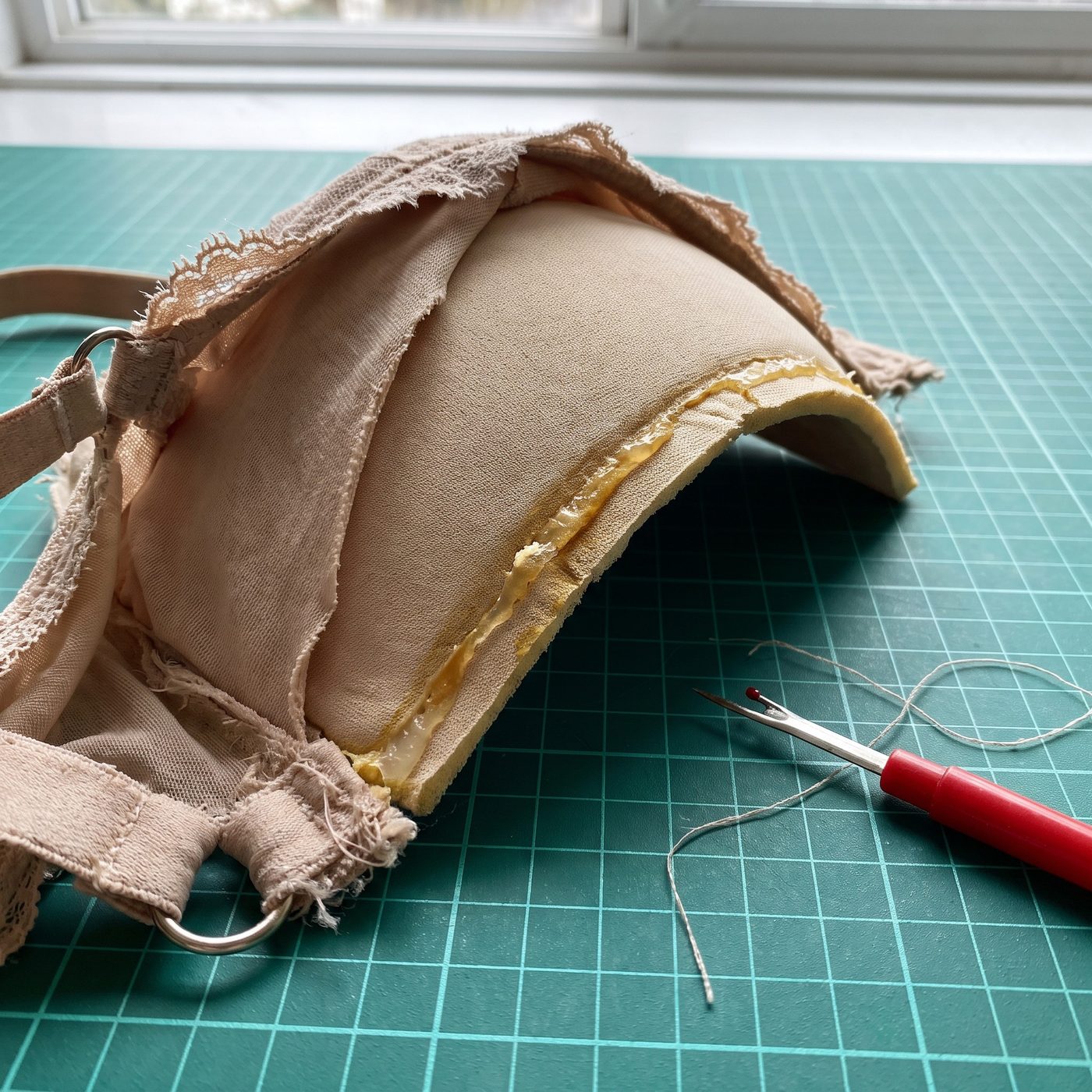
Seven of the eleven cups were held in by a bead of hot-melt adhesive run around the rim of the pad, with at most a single tack stitch. Dorothy knows the method because she watched plants switch to it. "Gluing a pad takes four seconds. Stitching it round takes forty." Hot-melt adhesive softens in warm water, and a warm cycle runs at the temperature it softens at. Every wash loosens the bond a little more; by somewhere between wash nine and wash twenty, the pad is free at one edge and folds the first time the drum turns.
The Underwire Channel Puts Its Load On Two Ribs, Not On The Breast

Four of the eleven had a wire. Dorothy slit each channel open and pulled the wire out. Every one of the four was straight-ended steel with a plastic tip, and on the minimizer the tip had worn clean through the channel fabric by wash 20 and was sitting against the lining with nothing between it and skin. More to the point, she laid each wire against her own ribcage. "The wire does not sit on the breast. It sits under it. Its two ends sit on bone, one by the breastbone and one under the arm, and the whole band pulls those two ends into those two ribs all day."
By Wash 20, The Band Elastic Had Let Go. That Is Why The Band Creeps Up.

Dorothy measured the relaxed band of every garment before the first wash and after the twentieth. Eight of the ten banded garments lay longer, by between an inch and a quarter and two and a quarter inches, an average of about an inch and six-tenths. When she cut the band casings open the reason was on the mat: the rubber threads inside the elastic had snapped in dozens of places, leaving the knitted cover with nothing to pull it back. "Heat does it. The dryer does it faster than the washer."
The Strap Groove You See In The Hall Mirror Is A Strap Under An Inch Wide

Dorothy measured every strap. Nine of the eleven were under an inch and a quarter wide, five under an inch, and all nine were a single row of stitching down each edge with a plastic slider halfway. "A strap that narrow with that much weight on it is a cord. It cuts a groove because it is shaped to." The next widest, on Brand A, was an inch and a half. The widest strap on the table was on the built-in-bra tank, and it was the only one Dorothy could lay three fingers across.
The Only One With The Cups Sewn In: What Dorothy Found When She Turned It Inside Out

The eleventh garment was a built-in-bra tank a neighbour had told Dorothy about. She expected a shelf camisole with a pad in a pocket. She turned it inside out and stopped. "There is a line of stitching all the way round each cup. Not a tack. Not glue. A proper seam, the way we did it in 1979 before anyone had a glue gun." The cups are shaped and stitched into the lining around their whole edge, so there is no pocket for a pad to slide in and no glue line for warm water to soften. After twenty warm washes the cups were exactly where they had been on wash one.
There is no band, because there is nothing loose that a band needs to hold up: the fitted body of the tank carries the cups and spreads the hold up and down the torso instead of on one tight strip across the ribs. There is no wire and no wire channel. The straps measured two inches flat, three fingers across, so the shoulder weight is spread instead of cut in. And there are no hooks. It pulls on over the head, which Dorothy, who fastens her own bras in front and spins them round because her shoulders no longer go behind her back, mentioned twice.

What Three WHI Readers Said After Their Own Wash Test
We asked three readers who swapped after reading Dorothy's table to wash the tank twenty times at home and tell us what they found inside.

"I did exactly what the article said. Twenty washes, warm, then inside out on the kitchen table. The stitching round the cups looked the same as the day it came. My old bra from the same month had a pad folded in half."

"I fasten my bras in front and spin them because my shoulders will not go behind me any more. This goes over my head. I did not realise how much I dreaded seven in the morning until that stopped."

"I measured my old band before and after like Dorothy did and it was nearly two inches longer. There is no band on this to measure. The strap groove on my right shoulder is gone after three weeks."

Ranked #1 of 11 — The Freeform Tank
- Cups stitched into the lining all the way round — the only one of the 11; nothing to fold in the wash
- No band, no wire, no hooks — no elastic to let go, nothing loading the ribs, pulls on over the head
- Straps three fingers wide — the widest strap on Dorothy's table
- Six colours, sizes S to 5XL — square neck, smooth plain front
What readers asked Dorothy first
Will the cups really not fold or come out in the wash?
They are stitched into the lining around their whole edge, not glued and not slipped into a pocket, so there is no free edge to hinge on and nothing for warm water to soften. Dorothy's tank came out of wash 20 with the cups exactly where they were on wash one. Warm wash, tumble low.
Can a tank with no band hold a fuller bust?
The hold comes from shaped cups stitched into the lining and straps three fingers wide, carried by the fitted body of the tank rather than a tight strip across the ribs. Dorothy tested a 38C. Order by your usual bra size from the chart on the order page, S to 5XL; if you are between sizes, take the larger one.
Why are the other brands anonymised?
So the ranking reads on construction. Glued pads, pocket pads and snapped band elastic are methods, not one maker's mistake, and Dorothy found the same methods across every price point she bought.
Is this a laboratory test?
No. It is one seamstress's teardown of eleven garments in one size on her own sewing table, with a seam ripper and a tape measure. We are reporting what she found inside and showing the one garment that was built differently.
Reporting by the Women's Health Insider desk. With thanks to Dorothy Kalman for a morning at her sewing table. This is an opinion piece informed by one seamstress's teardown and is not medical advice; individual experiences vary.